City of light
Rebecca Burton
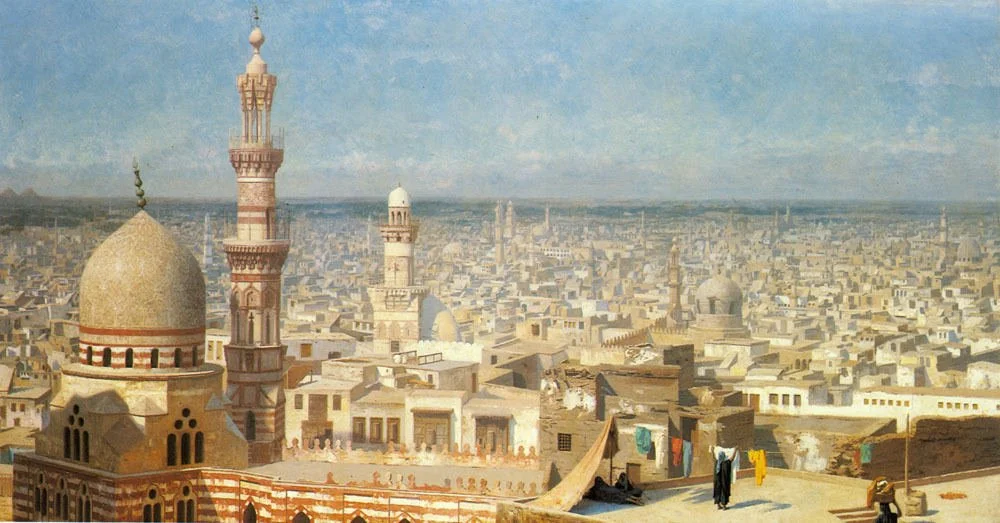
In Luka’s apartment in Cairo, there’s a chandelier. This is in 1993, the year we meet, the year I move in with him. The year I live overseas. The chandelier hangs suspended from a hook in the living room ceiling, an object of faded grandeur: crystals chipped, brass chain covered in a sticky, lacy skein of spiderwebs, its lights coming on a full beat after the switch is flicked. The whole apartment is like this, furnished in another era, a colonial era, when all the buildings in the street went up. They have carved stonework - arches, balustrades, gargoyles, even - but the façades are grimy, and the balconies are cluttered with pieces of broken furniture. Strewn with little piles of rubble.
Luka lives on the fourth floor. To get to his apartment you walk in, off the street, into the darkness of the lobby, where there are no windows, and the ceiling light is broken. There’s a lift, one of those old lifts built like a cage, with a grille door that you slide across and fasten, but no-one uses it because of its alarming sounds as it rises through the building, groans and creaks and screeches. So that leaves just the stairs. The windows in the stairwell are coated with a thick layer of grime, throwing the space into a cloying dimness, and the smell of cat piss hangs in the air. Sometimes as I climb, I hear odd, furtive scrabbling sounds in the corners, which I suspect are rats, though I’ve never seen any.
Look at me now, in my first week in this apartment, six weeks after arriving in Cairo. I came here to make a fresh start, and I’ve just signed a contract to teach classes in an English language college. Luka also teaches there, which is how we met. The day I move in with him, new and hopeful about everything between us, I find some cleaning things in a cupboard in the laundry - mop, broom, bucket, feather duster - and all that week, walking to work each morning, teaching classes, walking home in the evening, I think about cleaning the apartment. Maybe it will fix something, the clutch of fear inside me, which I still don’t understand. Which won’t release, even here.
Mornings on the street are: bright sunlight and busy traffic, the ta’amiyya man setting up his stall, the woman who sells aish baladi displaying her rounds of bread on a rug, on the footpath. Evenings are slanting sunlight, men sitting at tables outside the coffee shop on the corner, smoking water pipes and playing backgammon. The air is thick with petrol fumes and cooking smoke, and a ginger cat rakes through a pile of wood on the footpath, searching for food. It’s a mystery to me how the cats in Cairo survive: they are rangy, underfed creatures who sleep in abandoned buildings and narrow alleyways. And yet they do.
That sky. The light. Luka, who has lived here for three years, says to me one day, ‘You can go for months without seeing a cloud in this country.’
His soft English burr, the closed vowels, the way he says clodes instead of clouds. We’re sitting across the table from each other in a café in the Khan al-Khalili, drinking sahleb, to which he introduced me.
He says, ‘The first year I lived in Cairo, I really missed them. The sky’s so blue, you know? This vast, endless blue.’
He looks tired, not in the physical sense from too many late nights in a row, but in another way too, bone-deep. Yes, he admits when I ask him, he is tired.
‘I love this city,’ he adds, ‘I do. But it eats away at you.’
He told me once that when he first arrived, the streets, which teemed with people - people who walked and talked and laughed and shouted and argued and begged and wept - seemed to him like a living organism; a malignant, seething, writhing organism that belched smoke: cigarette smoke, cooking smoke, old-car smoke. People, more people. Cairo was people. And I think that this is what he is referring to, now; the exhaustion that comes from living in this city.
But he says, ‘No. I mean, this isn’t my home. It’ll never be home, not really.’
‘I feel,’ he says slowly, ‘like I’ve got no roots anymore. Like I’ve stayed away so long that I’m homesick here, but if I went back to England, I’d be homesick there too.’
Homesickness. Heartsickness. I want to say then that I understand because I do, although not in the way he means, or in a way that I will probably ever manage to say out loud, to him. There are the things I’ve told him about myself, like how I came here to make a fresh start (those same words again, the ones I always use when people ask me), and then there are things that I haven’t told him: my time in the hospital, my weeks on the Psych Ward last year. Ava the Antipodean, he calls me, and I like this nickname, how it combines endearment with estrangement. Maybe that’s who I am now anyway, here in Cairo, all the way over on the other side of the world.
***
Here now, a memory from the Psych Ward. A daytime session: group therapy with the other patients in the non-smokers’ common room, a small room with a faulty strip light, buzzing and flickering. Progressive muscle relaxation therapy, and we were all lying on the floor, while the nurse, from a chair in the corner, intoned, ‘Close your eyes, tense up the muscles in your feet, hold them tight, really tight, clench all the muscles in your feet, every single one … and release.’ With our eyes still closed, her instructions continued in one long sentence. ‘Now, tense up the muscles in your calves, hold them tight, really tight, clench all the muscles in your calves, every single one, and … release.’
Thighs next - then buttocks, stomach, chest. Hands, arms, shoulders, face.
Then:
Mouth.
Eyes.
Forehead.
‘Now breathe,’ she said, ‘just breathe, slow and deep, feel how relaxed you are, feel it all the way through you.’
She told us to remember this technique when we left, to hold onto it, so that we could use it when we need to. But what I remember are other things - people, not techniques. Middle-aged Helen, on the floor beside me, snoring gently: permed hair, thick glasses and even thicker lipstick, and that story she told me at lunch in the dining room. ‘I just couldn’t get out of bed anymore,’ she said; ‘I woke up one morning and I couldn’t do it - I couldn’t get up.’
Nathan on my other side, sleeping soundly, his Lithium finally kicking in. Me, opening my eyes – was I the only person to open their eyes during those sessions? - and gazing at Lucy, one of the anorexics, opposite. A blue vein in her forehead popped, and she was clenching her teeth and all of her muscles - clenching, clenching, just like the nurse instructed, though not to relax, never to relax, but to burn calories.
Lucy, who prowled the ward at night, lean and starving: something feline about her, something unkempt and mangy. Not like the cats in Cairo, because she was the opposite of a scavenger, doing the opposite of hunting for food. But still, that look she had, the look of a survivor.
***
On Saturday, my first Saturday in Luka’s apartment, I get up early. He isn’t awake yet, although he stirs and mutters something. At night, in his sleep, he is restless, making sudden, violent movements and uttering syllables, words and non-words. What does he dream about? He never tells me.
‘Go back to sleep,’ I murmur, and his eyelids flutter as though he hears, but then he rolls away, pulling the blanket over him, and turns to face the wall. Another string of non-words.
Look at me now, pulling out the cleaning things from the laundry cupboard. The laundry is a narrow room off the bathroom, with a twin tub washing machine which I’m secretly terrified of, and I see, belatedly, that the tips of the feathers on the duster are darkened with grease. But it will have to do.
And so, I begin. I sweep and mop and dust. In the spare room, I roll up the window sash and lean out over the sill with a bucket of soapy water to wash the shutters. Down in the street, there’s a squeal of brakes, the smell of burned rubber. Next, I go to the bathroom, where I pour bleach into the toilet bowl, and take a toothbrush to the blackened grouting between the tiles. In the living room, I dust all the furniture, even the wooden bookcase, even Luka’s books - an Arabic textbook, a volume about the history of Cairo, and several novels by Naguib Mahfouz, his favourite writer. The cleaning should soothe me, but it doesn’t. Finally, I drag a chair beneath the chandelier and climb onto it, reaching up with the feather duster.
That’s when he appears. He’s wearing the clothes he slept in, an old T-shirt and a pair of boxers. He tilts his head, gazing up at me from the doorway.
‘Are you seriously dusting the chandelier now, Ava?’
‘I am.’
He yawns. Stretches. Lean, strong muscles from the push-ups he does every day. I wish I was strong like him. (One day I will be strong like him). Sleep is crusted at the corners of his eyelids, and the bottom of his T-shirt rises as he lifts his arms above his head, so that I glimpse a strip of his belly. A thin line of hair running down from his navel.
He says, ‘Can I kiss you?’
He says, ‘I’ve just woken up, habibti, and I really want to kiss you.’
‘You can kiss me,’ I answer, pretending to be grudging, and I climb down and go to him.
‘There’s a smudge of dirt on your forehead,’ he says. ‘Here-’ (pressing his lips against a spot beneath my hairline). ‘Also here-’ (kissing my nose). ‘And I think maybe here-’ (laughing now, with his lips against mine). I open my mouth and we kiss more deeply. Luka and me, we’re always kissing that year, the year I move in with him, the year we live together.
When he pulls away, I ask him what’s wrong.
‘Nothing,’ he says. ‘I just want to look at you. I like looking at you.’
And here now, inconveniently, another memory from the hospital, another group session. This time we had to write down a list of all the things that we liked about our bodies. Body positivity, they called it, because you have to start somewhere, don’t you, when you’re trying to learn to like yourself. I like my nose because it’s small, Helen wrote, and then she added, warming up, growing bolder, I like the way it tilts up at the end. Nathan, who was in his early twenties, an ex-football player, wrote, I like my legs because they’re strong and they make me run fast. I watched him writing this, and then I watched him cross it out, and when I asked him why he did that - deleted his words - he said, ‘Because I can’t run at all anymore, now that I’m on Lithium.’ Lucy wrote nothing because that was her role as an anorexic obviously, to hate her body, though sometimes I thought she was just performing her self-hatred for us. Like, who would she have been if she actually admitted to not hating the way she looked? Not an anorexic, certainly.
‘Why?’ I say now to Luka when he says that he likes looking at me. ‘What do you like?’
And he says, smiling, ‘Everything, Ava.’
Which is an answer, I guess, although not a specific one. But one, in any case, that I can hold onto when I need to.
That Saturday we go to bed after midnight, but I can’t sleep. It isn’t really dark; it’s never truly dark in downtown Cairo. Splashes of coloured light filter through the thin curtains and play over the wall, thrown upwards from the headlights of cars passing four storeys below. I hear cats fighting, their yowls and hisses, and a man shouts in the distance. Streams of Arabic, vowels that come from the back of the throat, consonants bubbling up - like a foreign language, except that I’m the foreigner here.
Beside me, Luka murmurs in his dreams. When he flings out an arm, I flinch.
I try to sleep. Closing my eyes, I tense up the muscles in my feet, holding tight, really tight, all the muscles, every single one. Up through the body then, clenching and releasing, the way they taught us - calves, thighs, buttocks, stomach, chest. Hands, arms, shoulders, face. Mouth, eyes, forehead. In my memory I hear the nurse’s voice, her incantation: ‘Now breathe, just breathe, slow and deep.’
Afterwards, though, I’m still awake.
Just before dawn, the call to prayer begins, the muezzin’s voice drifting down from a nearby minaret and winding through the street. The fajr, it’s called, or so Luka told me, the first call to prayer of the day. The muezzin sings in a thin, unearthly voice. Luka wakes up too; he rolls over to face me, his eyes shining in the half-light.
‘It’s like the most beautiful song in the world,’ he says.
His voice is husky. Yesterday afternoon he sat at the living-room table doing his homework for the weekly Arabic class he goes to. Practising the script, learning new words. Habibti, my darling. Rohi, alb, aali, hobbi. My soul. My heart. My mind. My love.
He says, ‘Even the words of the call to prayer are beautiful.’
‘Can you say it for me?’
‘The whole thing?’
‘I mean, you know it off by heart, right?’
He says that he does. ‘Allahu Akbar, Allahu Akbar,’ he begins. ‘Ash-hadu alla ilaha illa-llah. Ash-hadu alla ilaha illa-llah.’Then he continues, one sentence after another. When he speaks the words like that, I see that he’s right, that there is a beauty to the sound of them, the phrases repeated and echoed. Like a circle. Like poetry. Like breath.
‘As-Salatu khairun min an-naum, As-Salatu khairun min an-naum,’ he says. ‘Prayer is better than sleep.’
We lie facing each other. His breath is warm on my face.
‘I didn’t sleep at all,’ I say, a confession.
The light in the room is growing brighter, and I see that he’s frowning, a worried frown.
‘Not at all?’
‘No.’
‘Why not?’
I could tell him now, I think. Here, now, I could tell him about everything: the hospital, the Psych Ward, the prescription for tricyclics - my anti-depressants - which I took for a while after I left the hospital. I could tell him that they made my mouth dry and gave me a tremor - not a tremor that anyone else could see apparently, but one that I could feel, my hands clumsy and fumbling, and so I left them at home when I flew to Cairo. I could tell him that I felt like Nathan when I was taking them, not knowing his body anymore. Not knowing himself.
Luka, lying beside me. (Feel how relaxed you are, feel it all the way through you.) I think it again: Tell him now, just tell him. But I don’t; I can’t. I’m not sure why, except that it has something to do with the morning sky through the window. That Cairo sky, blue and cloudless.
‘Ava? What’s wrong?’
‘Nothing,’ I say.
‘I’m fine,’ I say.
Because it’s over now anyway, the not-really-darkness. The night.
He kisses me then - more kisses, our own shared language, the language we are fluent in - and while we’re deep in our kiss, there is the sound of glass shattering. I think, panicked, that it’s the chandelier, the chain snapping, plaster flaking, crystals hitting the floor. All those chipped crystals, smashed and broken. Like the end of everything. But the sound comes from outside - the roar of a motorbike, a baby wailing - and so it’s not the end, after all. It’s a beginning, first light. The start of a whole new day.
Nothing is broken, I tell myself. There is nothing to worry about, nothing I need to tell him, nothing at all.
Look at me repeating these words to myself. I say them like a chant; I say them like a prayer. An invocation. They are not poetry, they are not beautiful, they are not a release, but this is me, trying - look at me trying - to believe in them.
A Note on the Author:
Rebecca Burton’s novella, Ravenous Girls, won the 20/40 Publishing Prize and was named one of the 25 Best Australian Books 2023 by the Guardian Australia. The author of two young adult novels and several anthologised or forthcoming short stories, she blogs about books, birds and words at twenty-one-words.com and on IG (@twenty.one.words).