My south pole
Olga Mallo
“When I was very young, I had a dream and promised myself that I would make it come true. One day I would go to the region of ice and snow and keep going until I reached the poles of the Earth, the end of the axis on which this great round ball turns.”
Sir Ernest Shackleton
***
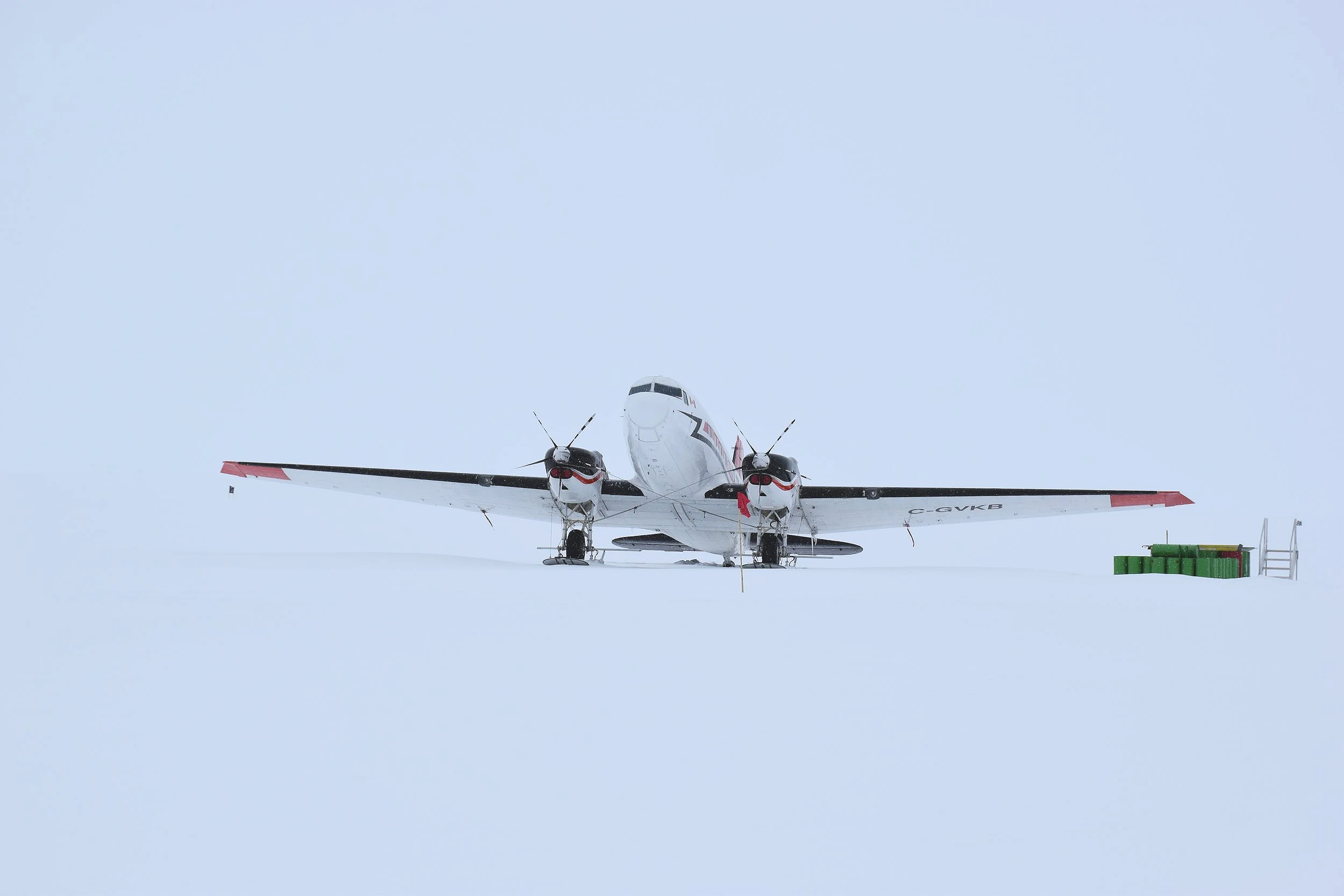
“Fasten your seat belts, we are about to land at the South Pole.” The voice of Captain Jim Haffey fills the cabin.
I have arrived at the southernmost point of the planet, in the comfort of this plane, without having endured any of the epic adventures had by the heroes of the golden age of polar exploration, and soon, the skis of this refurbished DC-3 will rest, and bounce lightly upon the white polar plateau.
I and the other eleven passengers, plus the three aircrew, will now put on the final two layers of clothing before the door opens. Although the sun is shining in all its splendour, and is statistically at least, a magnificent and “warm” summer’s day (it is January), the thermometer reads -15°C, which is cold enough to cause havoc to our bodies, without the required four layers. Moreover, John Apps, the medical doctor travelling with us as part of the company’s logistics team, warns of the possibility of altitude sickness. Though the South Pole looks like an endless plain, it is in fact 2,800 metres above sea level.
Preparing to exit the aircraft, emotions gather with quickening heartbeats and knots in throats, in anticipation of fulfilling dreams. Waiting for us outside, is a smiling Hanna McKeand, our hostess here at the end of the world, and camp manager for Antarctic Logistics & Expeditions (ALE), the company in charge of this journey. Soon after she issues us with instructions, we all approach the Ceremonial Pole, a sort of mirrored crystal ball that reflects not only our image, but the twelve flags surrounding it, and the vast white expanse behind us. The flags represent each country that signed the original Antarctic Treaty in 1959, although, by the rules of the Treaty, none owns a single millimetre of the continent; Antarctica “is a protected natural reserve, used only for peace and scientific research.”
A photo at this ceremonial landmark is de rigueur, and creativity flows as people aim for the most striking image for social media. I must wait my turn, however. An important family reunion is about to take place around the famous sphere.
On the flight from Union Glacier, Rosalind, Matthew and Barbara travelled with us, to reunite with their family who had arrived at the Pole some hours before. But the Edwards-Smiths are no ordinary family. Guided by the British explorer David Hempleman-Adams, Steve, Rosalind’s husband, and their two daughters, had, on skis, pulled their sleds, laden with tents and provisions, and completed in two weeks, “the Last Degree” - the name given to the 111 kilometres from the 89th to the 90th parallel - finally reaching this most southerly point on earth, the South Pole.
Six months prior to this, they had gathered at the other end of the earth, at the North Pole. This means that today they have set the record of putting both the oldest person ever (Barbara, eighty-nine) and the youngest (her granddaughter Mimi, aged fifteen) on both axes of the Earth.
Today’s expedition is going to be around three hours before getting back to ALE’s base camp at Union Glacier. At first, this seems excessive for a place that appears, at first sight, rather meagre. Apart from two photographic landmarks, there is only the United States scientific research station, normally closed to visitors, and the ALE camp a few metres away from the Pole, for the clients who have chosen and paid for the “overnight” tour option.
Nevertheless, the three hours pass quickly. We are fortunate that a couple of scientists from the Amundsen-Scott US base are enjoying a laid-back day and offer to show us around the massive bunker-style station. It is certainly a place where one would wish to be in the event of a nuclear holocaust, given that the chances of survival – and with some comfort even - would undoubtedly be higher.
The Geographic South Pole is where I head next. It is, in fact, the true southernmost point on Earth. Only fifty metres away, the walk, with my four layers of clothing, is slow and the distance feels longer. The snow dazzles, and goggles are essential. Sunglasses are not enough, as the reflection from the sun on the snow can literally burn one’s eyes. To combat the cold, inside my gloves are hand-warmers, small disposable sachets containing a chemical solution that releases heat as it crystallises. The difference between enjoyment and misery here depends entirely on having the right equipment. Thanks to modern fabrics and materials, the cold should not be an issue, yet our hosts stress caution; more than a minute without gloves - whether to take a picture or zip a jacket – and the exposed skin will suffer.
That afternoon, the temperature drops to minus 20°C, and as I trudge across the ice, I think of Roald Amundsen and Robert Falcon Scott’s courage over a century ago; to reach this point, they had travelled thousands of kilometres across this striking but merciless continent, with none of these modern comforts. On a sign at the Geographic South Pole are the messages both had left on their arrival, and when I, too, get there, I silently pay homage to them.
Marking this most southern tip, is a metal plaque, made every winter, by US base scientists, to mark the exact location of Earth’s axis. On the 1st January every year, they have to replace it, because each year, the Antarctic ice-sheet drifts around ten metres. The ritual has been carried out since 1959, and the previous fifty-eight plaques are displayed in glass cases at the base.
As all time zones converge at this point, a half-minute spin around the plaque is all it takes to make the traditional ‘trip around the world’, and then, before returning to the plane, Hanna takes me by snowmobile to the ALE camp, located 500 metres from the Pole. It consists of ten heated tents, each with beds, tables, and enough space in which to move around. There is also a lounge and dining tent, where Patricio, a Chilean chef, serves delicacies worthy of a multi-star restaurant. Today, however, I have time only for tea, as the flight to Union Glacier is imminent.
On the return flight, which lasts just over four hours, Captain Jim invites me into the cockpit. The view is breathtaking. On the horizon, the snow-capped Thiel Mountains break the flat infinite line of the Antarctic plateau, and despite it being nine o’clock at night, the blue/white polar ice is still illuminated by the sun; the summer solstice is three days away, so at this time of year, in Antarctica, the sun will not set.
In the passenger cabin, most people are sleeping, including the Edwards-Smith family. After their reunion here, they will take the first flight from Union Glacier to Punta Arenas, and from there, back to the United Kingdom. Barbara, the eighty-nine years-old grandmother, is awake, and I ask her what this record means to her.
“For me,” she replies, “the important thing is to do things as a family - whether it’s a picnic in the park or coming to the Pole. For me, the record was just an excuse to share the experience with my granddaughters.”
Landing on the snowy runway of Union Glacier, Barbara climbs down unaided, and takes Rose’s arm only when walking across the slippery terrain to the camp, proving to be one of the most admirable characters I have encountered here on the White Continent.
It was only that morning that we had taken off for the South Pole, yet upon our return to the ALE camp, it was as if we had been gone from this ‘civilisation’ for days.
Just twenty-four hours earlier, we had landed on the blue ice ALE runway at Union Glacier, the glacier which also houses ALE’s main base camp. From the company’s headquarters in Utah, USA, and Punta Arenas, Chile, ALE organises these flights aboard the colossal double-cabin Russian aircraft: the Ilyushin 76.
When I speak of civilisation here in the Antarctic interior, I mean an almost science-fiction world, a parallel universe, created by ALE, and imagine that a Mars base would function similarly - efficient despite its remoteness.
Prefabricated buildings assembled here include an operations centre where decisions are made, in conjunction with managers from the ‘outside world’; a communications office with modern systems to coordinate flights and monitor satellites that track crevasses and terrain, and a meteorological office that relies on satellite imaging and numerous weather stations installed across the continent.
The medical centre not only has a large stock of medicines but also two full-time doctors. Several restroom facilities are equipped with systems that ensure all human waste is flown back to Punta Arenas, thereby maintaining the pristine environment demanded by the Treaty.
There are even telephone booths with satellite phones for those who have not brought their own. Supporting all this is a fleet of massive all-terrain vehicles with enormous wheels, most of them painted bright orange to stand out against the blinding white landscape – like a scene from a Ridley Scott film.
That evening, a meal prepared by Nestor, a talented Indonesian chef awaits us and, while sharing the excitement of having stood at the end of the world, we learn that, after our departure, a severe storm had hit the South Pole, grounding flights for several days - a common occurrence. Travelling to such extreme places requires patience, flexibility, and a generous time frame. ALE stresses this in its briefings, making only one promise: no one will leave without completing their purchased programme.
The next day, we celebrate with an opulent banquet, receiving certificates commemorating our journey to the South Pole. As for me, I do not consider it a personal success. I boarded a plane, landed there, took hundreds of photographs, had my passport stamped, and enjoyed it. I am almost embarrassed to receive the certificate, knowing that while we feast on a gourmet meal and sip Dom Pérignon, there are two men, on an even more remote part of the continent, vying for the record to be the first to cross Antarctica from coast to coast.
For over a month, thirty-four-year-old Colin O’Brady from USA and forty-nine-years-old Louis Rudd from UK, have dodged crevasses and skied across the bleak terrain, hauling heavy sleds piled with dehydrated food and tents, and camped in the midst of violent storms. O’Brady, two days ahead of Rudd, would finish after 56 days, a week after our celebration dinner. Their polar race sparks heated debate in specialist circles; some argue they were not the first, others that they had not started on the coast but the ice sheet, and others still protested that, with the logistical assistance that they had had, they had not been unsupported as they had claimed to be. The definition of Antarctic exploration in the twenty-first century clearly remains a subject of discussion, although the meaning of adventure remains, nevertheless, relative, and subjective.
I encounter my own, on the fifth day of my stay at base camp. My original plan had been to remain in Antarctica for six days, but the weather turns bad on the fourth, and does not improve. The horizon dissolves into a uniform white-grey, and snow falls consistently on a continent known as the world’s driest desert, yet this season has brought the harshest summer in decades.
With no return flight in sight, ALE’s guest manager Carolyn Bailey announces to the eighty passengers waiting to depart to Punta Arenas, that poor weather will persist for several days. I decide then, to stop procrastinating, and to take the plunge, and shower.
The instructions for using the shower facility had seemed an arduous task, so I had resigned myself to dry shampoo and wet towels for six days. But with the announcement of delay, and the encouragement of some of the ALE staff, whose shiny hair proves the efficiency of the showers, I convince myself to go for it.
The shower facility is heated, and is made up of three stalls and a sink with extremely hot water. Outside the cubicle, I first fill half a bucket with the hot water, then from the pile of snow blocks there, I gradually add enough until I get the temperature comfortable enough to wash in. Inside the cubicle, there is a hose with a small pump connected to the showerhead. This, I place it in my bucket, before stepping under the shower. My fear - that the water would run out mid-rinse - vanishes when I see that more than half the bucket remains, even after shampoo and conditioner. That night, I feel as if I am wearing a new dress, such are the pleasures of stepping outside one’s comfort zone.
Days slip by at Union Glacier. Each morning begins with the same ritual: I emerge from the sleeping bag, use the pee bottle (at which I am becoming more adept), brush my teeth with snow gathered outside the tent, and don the three layers required to step outdoors, plus hat, gloves, and goggles. I then head off to breakfast, in Fram, the dining tent, named after Amundsen’s ship. (ALE’s tents are named after Antarctic heroes, and mine bears the name of the German explorer, Filchner). Snow has fallen so heavily in recent days that my mandatory moon boots sink deep into the snow on the two-hundred-metre walk there.
A list of suggested activities is provided daily on a board at the Fram. These include visits to geological formations with names such as Elephant Head and Ice Wall, randonnées (ski excursions), snowmobile rides, hikes in the surrounding area (guided due to the risk of crevasses), talks from Antarctic experts, and trivia nights that bring together the more than 150 temporary residents of this unusual village.
More than twenty nationalities gather at ALE’s camp each season, staff and guests alike. Each person is here to pursue a dream. There are mountaineers aiming to summit, adventurers wanting to ski different parts of the continent, groups camping beside emperor penguins at Gould Bay, skydivers awaiting clear skies, or visitors seeking Antarctic luxury at ALE’s new Three Glaciers camp. Some, like me, dream only of standing at the South Pole. Others are content simply to spend time at 79° latitude, deep in Antarctica.
The day after Christmas - Boxing Day - the abundant mulled wine has left its mark on many, but the sky finally clears to a radiant blue. The Ellsworth Mountains reappear in full splendour, and Union Glacier becomes a sheltered valley once again. It is a perfect day for skydiving, and for the landing of the Ilyushin.
By late morning, the group of skydivers boards a Twin Otter aircraft, and soon we watch them descend gracefully into a drop zone marked with orange flares. I head over to the spot where wide-tyred bicycles are available for guests, and take one out for my last nostalgic tour, after which, it is time to pack and tag my luggage for loading onto the Ilyushin.
Everything is perfectly organised. Since 1985, when ALE discovered this patch of blue ice suitable for building a runway, Antarctic tourism, which had previously been restricted to the coast of the Antarctic Peninsula, changed for good. That year, they began by offering logistic support to climbers wishing to summit Mount Vinson, Antarctica’s highest peak, and in 1988, they organised the first guided expedition from the Weddell Sea coast to the South Pole. Today, this route is one of many that they offer between November and January, while also providing support for scientific operations, and collaborating with governments that maintain Antarctic bases, working always in accordance with the Antarctic Treaty.
“The plane is on its way to pick us up. It left Punta Arenas at 6 pm,” we are told. At base camp, we follow Chilean time, so the Ilyushin will land in four hours.
Around midnight, under a brilliant sun, I board one of the orange Caterpillars for the eight-kilometre ride to the runway. Gazing out the window, I understand how it captivated those heroes of the golden age of Polar exploration with its silence and lonely beauty; it is like a sleeping beast that could awaken at any moment, and holds the allure and danger of a siren’s song.
The Ilyushin waits on the blue-ice runway. It is time to be swallowed up by the great bird, and to return to reality. Eighty of us board, along with the Russian crew led by Captain Vassily. We come from diverse cultures and backgrounds, yet as we fly back, we share an experience difficult to convey to the outside world. It will remain a secret code inscribed in our DNA, binding us forever, even though it may be the only thing we have in common.
A Note on the Author:
Olga Mallo was born in Chilean Patagonia. She studied English Philology, English Literature, and Education at the Pontificia Universidad Católica in Santiago de Chile. Keen to explore other fields, she dedicated many years to fashion styling, which eventually led to her work as a translator and associate editor for Chilean Vogue. At the beginning of the millennium, she moved to British Columbia, Canada - an experience that awakened her passion for traveling and the outdoors.
Having lived between Patagonia and France, she has now spent nineteen years in the United Kingdom as a correspondent for various Chilean media outlets. Though she covers news, politics, and royalty, travel writing remains her true interest, with regular contributions to El Mercurio and Outside Chile Magazine.
She does not count the countries she has visited - “the list does not shrink; it becomes infinite.”